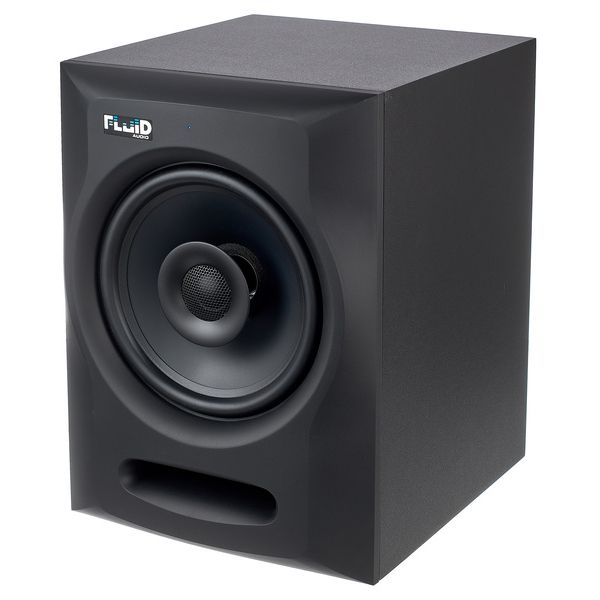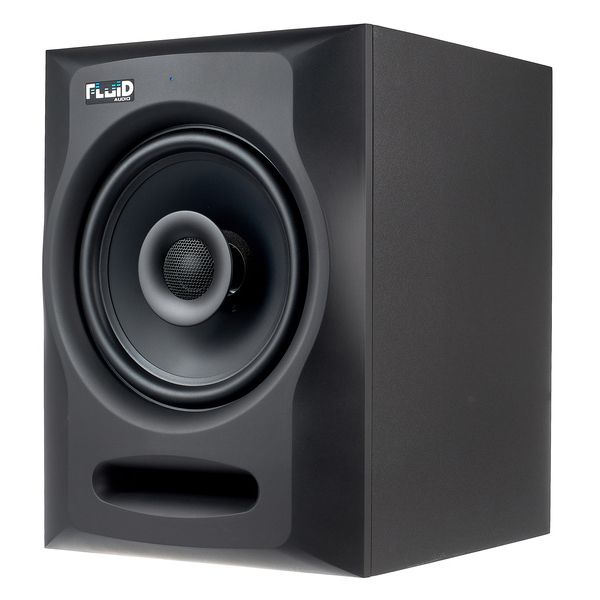


Fluid Audio is one of those brands that most people walk right past because the name doesn't carry the weight of an Adam, Genelec, or even Kali. Their loss. The FX80 V2 is a coaxial 8" monitor that punches absurdly hard for what it costs, with a couple of quirks you should know about before buying.
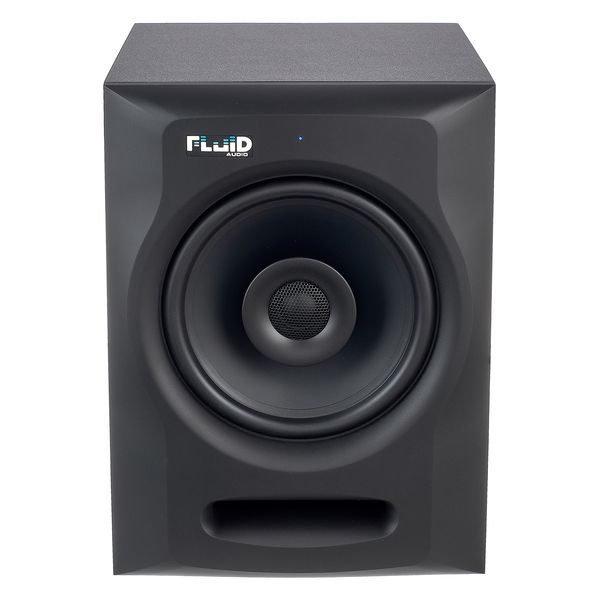
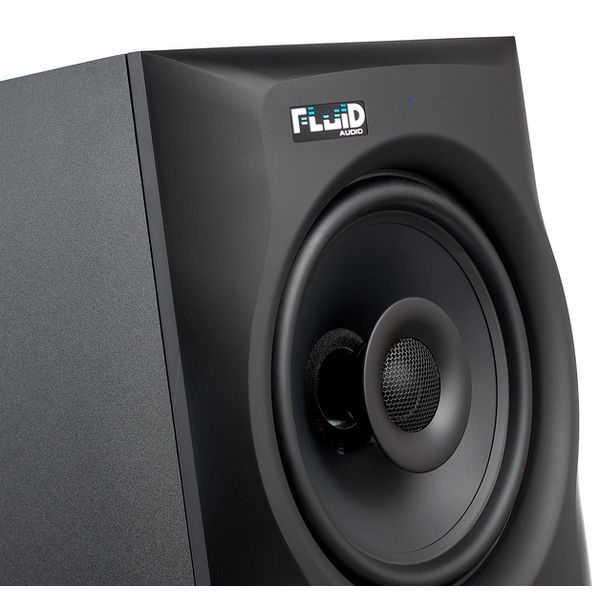
The party trick here is the coaxial design, the 1.2" silk dome tweeter is mounted directly in front of the 8" paper cone woofer, so everything radiates from a single point source. This isn't just a marketing gimmick. In practice it means the phase coherence between drivers is excellent, and the imaging has a depth and precision to it that conventional 2-way designs with separated drivers struggle to match. You get a genuinely holographic center image when these are set up correctly, and the off-axis response stays more consistent than you'd expect. It's the FX80's strongest trait by a wide margin.
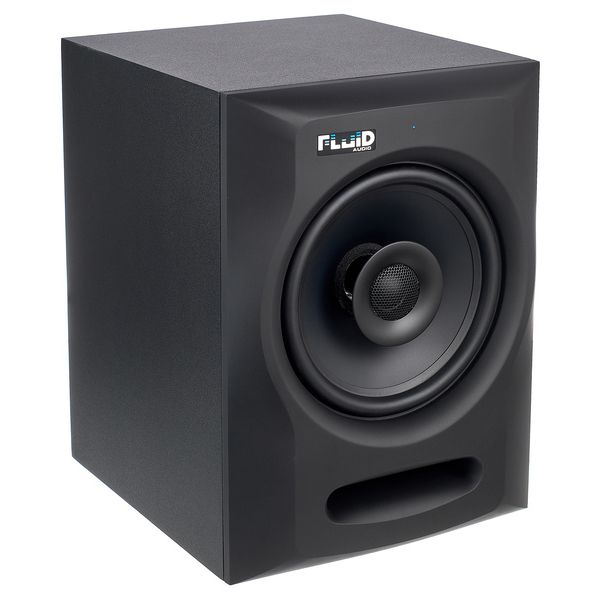
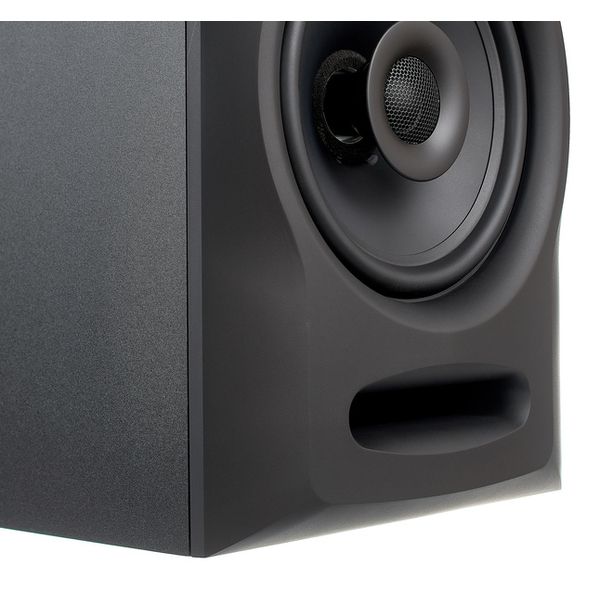
The low end extends to about 35Hz at ±3dB, which is legitimately deep for any nearfield 8". The front slot port keeps things clean and placement-flexible. There's real weight down there, and it handles bass-heavy material without embarrassing itself. That said, and this is worth being honest about, the bass isn't the tightest you'll find. It has a slightly softer, slower character compared to monitors with more aggressively tuned transient response. It's not sloppy, but if you're coming from something really snappy in the low end, you'll notice a difference.
The midrange is where things get interesting. The V2 addressed the original FX80's frequency response unevenness by applying additional DSP biquads to flatten things out, and it's better. But there's still a subtle scoop through the lower mids that gives the speaker its characteristic sound. Some people love this because it makes dense mixes feel more open and breathable. Others will find it deceptive, because that openness can mask congestion you'd catch on a flatter monitor. It's a tradeoff worth understanding before you commit.
The highs are sweet, smooth, and non-fatiguing. You can work on these for extended sessions very easily. Detail retrieval is good without being analytical. Not the last word in air or extension, but it does nothing wrong.
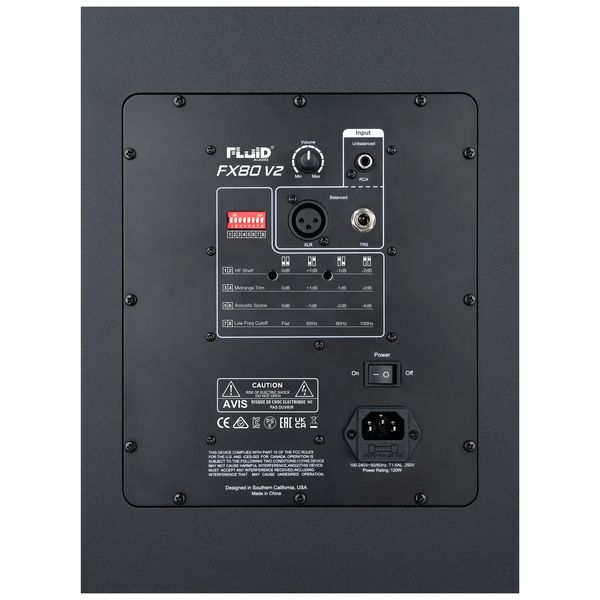
There is plenty of headroom for nearfield use. DIP switches on the back handle room correction. Build quality is solid MDF, nothing fancy but nothing cheap either. The "keyhole" baffle design with the curved radius actually serves a purpose as it reduces cabinet edge diffraction.
Comparisons with other monitors I own(ed):
vs. Adam T5V: The T5V's ribbon tweeter gives it a sharper, more detailed top end with that characteristic Adam sizzle. The FX80 V2 is smoother up top and has more low-end capability. Imaging on the FX80 is substantially better thanks to the coaxial alignment. The T5V is brighter and more forward; the FX80 is warmer, deeper, and more spatially coherent. Different tools for different jobs the T5V works as a secondary check monitor, the FX80 works as a primary.
vs. Kali LP-8 V2: The LP-8 is the more neutral, more analytically honest monitor. Its midrange is flatter and more present, its bass is tighter with faster transients, and it's arguably the better mixing tool if accuracy is your top priority. The FX80 counters with superior imaging depth from the coaxial design and deeper bass extension on paper. But the LP-8's overall tonal balance is less colored. If you want truth, LP-8. If you want imaging and a slightly more musical presentation, FX80.
vs. Genelec 8030: The 8030 is a masterclass in engineering packed into a 5" enclosure: tighter, more precise, better controlled directivity, and built to survive the apocalypse. But it's a 5" monitor that costs considerably more. The FX80 V2 gives you deeper bass, more output, and better imaging for less money. The Genelec wins on accuracy, build quality, and long-term reliability. On performance-per-euro, the FX80 is hard to argue against.
vs. Kali IN-8 V2: The IN-8's 3-way coaxial design is the more sophisticated implementation: a dedicated midrange driver means cleaner separation, and the imaging is precise. The IN-8 is flatter, more revealing, and handles complex material with more composure. The FX80 is competitive on soundstage depth but can't match the IN-8's midrange clarity or tonal neutrality.
vs. PreSonus Eris E8 XT: Both are laid-back monitors, but they get there differently. The Eris is relaxed across the board with slower transients and a recessed midrange. The FX80 has a similar warmth but adds excellent spatial presentation that the Eris can't touch. The Eris has more flexible tone controls. In terms of raw tonal accuracy, neither is class-leading, but the FX80's coaxial imaging advantage is real.
vs. Eve Audio SC207: The Eve plays in a higher league. The AMT ribbon tweeter is on another level, DSP implementation is more refined. The Eve's woofer only reaches about 44Hz though, so the FX80 digs deeper. If budget isn't the constraint, the SC207 is the more polished monitor. If it is, the FX80 gets you surprisingly close in imaging quality at a fraction of the price and that's the coaxial design earning its keep. But the IN-8 is still the smarter choice if stacking it against the SC207.
The FX80 V2 isn't the flattest or most analytical monitor in its price range, and it won't pretend to be. What it does better than almost anything at this price is throw a deep, coherent soundstage with pinpoint imaging. If spatial accuracy matters to you, this is one of the best value propositions in budget monitoring right now. Just know that you get: a slightly warm, slightly scooped presentation that trades some midrange honesty for an addictive sense of depth.